The hidden adaptations that let wildlife thrive on the ice
How do polar animals survive the cold?
Discover the Arctic“How does anything survive down there?” It is the question travellers always have a curiosity about, usually while looking out at a shoreline where the air sits far below anything a human body could tolerate unclothed. It is a fair question. The animals that draw people to the ends of the earth are not merely toughing out the cold. They are built for it, down to the chemistry of their blood, in a world that would kill an unprepared visitor within hours.
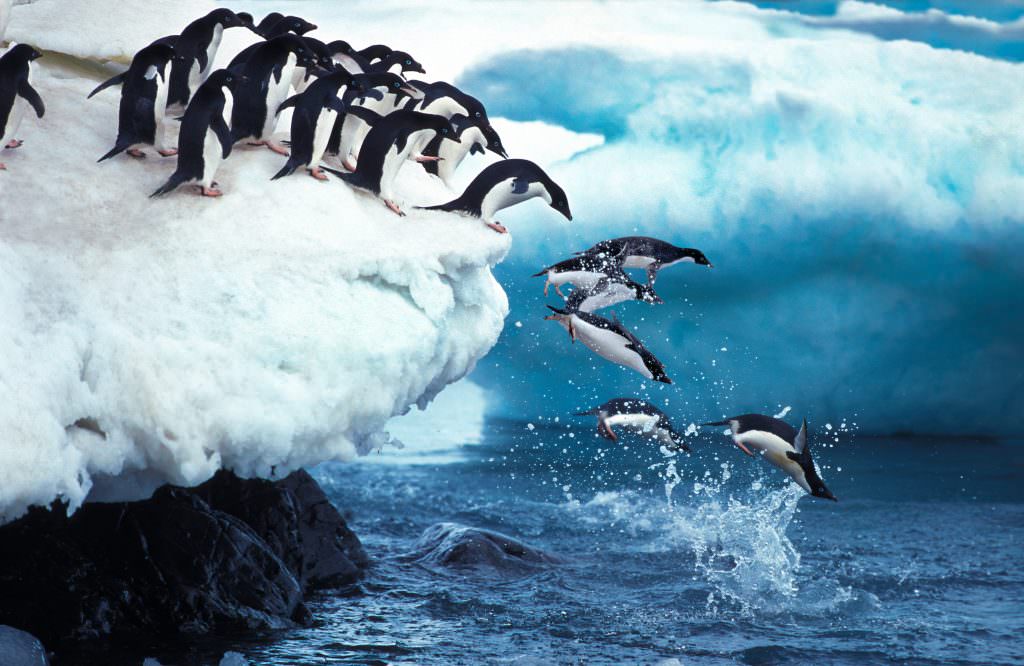
It is tempting to picture polar animals as ordinary creatures wearing thicker coats. Insulation matters, certainly, but the more remarkable adaptations are the ones nobody can see. Consider the problem a penguin faces every moment it stands on ice. Its body core must stay warm, yet its feet are pressed against a surface colder than a freezer. Bare skin on frozen ground ought to bleed heat until the whole animal chills. It does not, and the reason is a piece of plumbing that runs through the legs and flippers of penguins and through the flippers and tails of seals and whales alike.
The trick in the tissue
The mechanism is called countercurrent heat exchange, and once understood it changes how a person sees every animal on the ice. In the narrow extremities, the warm blood leaving the body core runs alongside the cool blood returning from the tip. Flowing in opposite directions and pressed close together, the outgoing blood hands its heat across to the incoming blood before it ever reaches the cold end of the limb. The warmth is recycled inside the body rather than surrendered to the air or the water. By the time blood arrives at a penguin’s foot it has already given up most of its heat to the blood heading back inward, so very little is lost to the ground.
This is why a penguin can keep its feet just above freezing by regulating the flow of blood to them, warming them only as much as they need. The same bare feet become useful in the other direction too. On a mild day, or after the exertion of a long walk, a penguin can open the taps and let excess heat escape through those same extremities. The feet are not a weakness the bird endures. They are an adjustable radiator.
Emperor penguins carry this thrift a step further. Much of the warmth in the air they exhale is recovered through the nasal passages before the breath leaves the body, so the animal is not constantly breathing its heat away into the Antarctic winter. It is the kind of detail that rewards a naturalist’s attention. Every degree the bird makes, it seems determined to keep.
Warmth as a shared project
The emperor’s most famous adaptation, though, is not something an individual does at all. It is something a thousand of them do together. Through the deep Antarctic winter the males spend much of their time huddled, and the huddle is a piece of engineering. Pressed tightly together, the birds present far less surface to the wind, and each animal’s energy use falls sharply as a result. Inside the mass the temperature climbs above freezing, at times rising above twenty degrees, which is an extraordinary figure to contemplate in the coldest, most exposed place on Earth.
What makes the huddle worth watching is that it moves. Small shuffling movements ripple through the group as a slow wave, roughly every thirty to sixty seconds, and the effect over time is that birds stranded on the cold windward edge are gradually carried in towards the warm centre while others take their turn at the outside. No individual bird is running the show. The pattern emerges from thousands of small adjustments, and the upshot is that the colony survives the winter as one body.
Blood, blubber and antifreeze
In the water the rules change again. Fur, so useful on land, loses much of its value once an animal is wet, which is why the great insulators of the sea are made of fat. Blubber keeps seals and whales warm where fur cannot, and it doubles as an energy store for the lean months. Its thickness can be startling. A bowhead whale carries blubber tens of centimetres thick, up to around forty or fifty centimetres in places, the thickest of any whale, a living wall of insulation between the animal and the near-freezing sea.
Stranger still are the fish. In Antarctic waters the sea sits near minus 1.9 degrees, cold enough that an ordinary fish would freeze solid as ice crystals seeded and grew inside it. Antarctic fish avoid this with antifreeze proteins in their blood. These proteins seek out the tiny ice crystals as they begin to form and bind to them, halting their growth before they can spread, which effectively lowers the freezing point of the fish and lets it live in water that should turn it to ice. The icefish go further into the improbable. Their blood carries no haemoglobin at all and so runs clear rather than red. They get by on oxygen dissolved directly in their plasma, which the very cold water holds in generous supply, aided by an enlarged heart and an unusually rich network of blood vessels. It is one of the few vertebrates on earth with colourless blood, and it lives only here.
On land the fur specialists have their own solutions. The Arctic fox grows a coat that thickens dramatically for winter, keeps its ears and muzzle short so there is less surface to lose heat from, and even grows fur on the soles of its feet. In the worst of the cold it curls into a tight ball with its tail wrapped over its face, and stays active where most animals would shut down. In the Arctic too, the polar bear layers transparent, hollow-cored guard hairs over dense underfur above black skin and a thick cushion of fat, with small ears and a small tail to conserve warmth. The bear looks white only because those hairs scatter light. The hairs themselves have no colour at all.
There is one thing worth settling for anyone tempted to picture bears and penguins sharing a beach. They never do. Polar bears live only in the Arctic, and penguins almost entirely in the southern hemisphere, an entire planet apart.
A traveller will not see all of this. The emperor’s winter huddle happens in the dark months, long before the first ship of the season arrives. But the whales working the summer feeding grounds, the penguins porpoising back to a colony, the seal asleep on a floe with its warmth held close, are exactly what a voyage in season puts in front of you. Knowing what is happening inside them changes what you are looking at.
Nothing out there is simply putting up with the cold. Every one of these animals, hair by hair and molecule by molecule, was shaped to live in it.